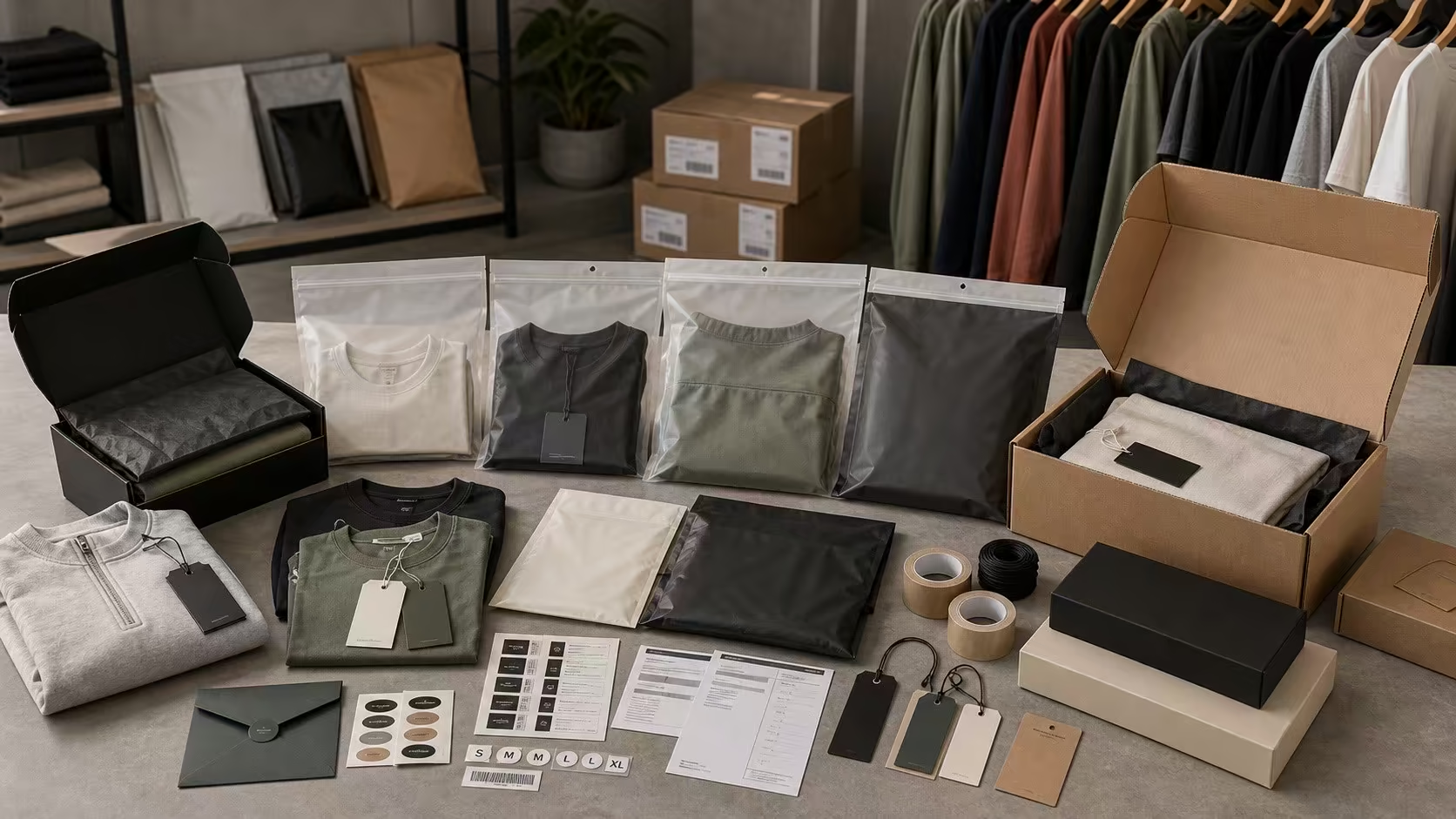
Apparel packaging commitment control
How to Plan Custom Apparel Packaging MOQ Without Obsolete Inventory
Compare packaging routes through component minimums, stable and variable data, expected consumption, version changes, storage, rework, and release evidence—not unit price alone.
Direct answer
Plan packaging around the smallest irreversible commitment
List every packaging component and identify its supplier, current minimum or unit bundle, setup, version scope, expected use, active SKU coverage, storage, delivery, and change trigger. Keep stable brand elements separate from variable size, SKU, barcode, market, claim, campaign, date, or channel information. Then compare stock, semi-custom, short-run, and fully custom routes using the same packed-product requirements.
Critical limitation: there is no responsible universal packaging MOQ or guaranteed low-risk route. A lower unit price can create a larger total exposure when unused components become inaccurate, damaged, unavailable, noncompliant, or unsuitable after the garment, assortment, barcode, artwork, channel, destination, or pack dimensions change.
The commitment stack
Separate six quantities before comparing a packaging quote
“MOQ” is only one field. A buyer needs to know what is being purchased, what will be consumed, what may remain, and who controls it.
| Quantity | What to record | Why it matters |
|---|---|---|
| Product demand | Planned garment units by style, color, size, SKU, channel, destination, launch, reorder, and scenario. | Shows the actual units expected to consume packaging rather than using one collection total. |
| Component requirement | Units of each label, tag, sticker, bag, box, insert, inner pack, or carton required per sellable unit or shipping unit. | Converts product demand into component demand and exposes components shared across several SKUs. |
| Supplier commitment | Current MOQ or bundle, setup, tooling, proof, sample, overrun or underrun rule, defects, freight, payment, and lead-time boundary. | Defines what the buyer actually commits to, not only the quoted per-piece price. |
| Expected consumption | Base, conservative, and upside use by a named date, including samples, damage allowance, replacements, and reorders. | Shows whether committed packaging is likely to be consumed while the version remains valid. |
| Inventory exposure | Committed units minus recorded use, plus storage, inspection, rework, relabeling, disposal, or write-off assumptions. | Makes excess quantity and operational burden visible before approval. |
| Change exposure | Which event invalidates or restricts the component: SKU, barcode, size, copy, language, market, claim, campaign, address, artwork, pack size, product, channel, or regulation. | Identifies the components most likely to become obsolete even when physically usable. |
Four packaging routes
Choose customization after defining the packed-product job
Packaging must still fit, identify, protect, present, scan, pack, ship, and satisfy the actual destination workflow. A simpler route is useful only when it performs the required job.
| Route | Control logic | Advantages to test | Risks to record |
|---|---|---|---|
| Stock | Use available neutral components and add only required identification. | Smaller commitment, faster replacement, flexible product changes, and reusable stock where specifications match. | Limited dimensions, finish or brand expression; stock availability can change; added labels and labor still require control. |
| Semi-custom | Keep the main bag, mailer, or box neutral; place brand or variable data on stickers, tape, cards, sleeves, tags, or labels. | Separates stable structure from changeable identity and can reduce the quantity exposed to one version. | More components, application labor, placement variation, rework, surface compatibility, and pack appearance. |
| Short-run print | Use a supplier-confirmed process for smaller project-specific versions where available. | Useful for testing artwork, channel, campaign, format, or pack response before a larger commitment. | Higher unit price, process limits, color or finish variation, supplier availability, and repeat-order consistency. |
| Fully custom | Commit to project-specific structure, dimensions, material, print, finish, tooling, insert, or closure. | Can integrate fit, protection, presentation, and brand requirements when volume and specifications are stable. | Setup, longer lead time, larger commitment, version-specific inventory, storage, freight volume, change cost, and future continuity. |
Eight-step plan
Build a packaging decision that can survive a product change
- 1
Map the sellable and shipping units
List each active garment SKU, bundle, player pack, retail unit, ecommerce parcel, wholesale inner pack, and master-carton route. Record which channel and destination uses each one.
- 2
Build the component bill
Give every garment label, hangtag, sticker, barcode, bag, tissue, card, box, tape, divider, inner pack, carton, and mark a component ID. State the quantity required per unit and whether it is mandatory, optional, shared, or channel-specific.
- 3
Separate stable from variable content
Mark every field that can change: product name, size, SKU, barcode, language, fiber or care information, origin, responsible business, address, price, claim, campaign, season, team, player, marketplace, or destination. Keep volatile information off high-commitment components when the pack design and requirements allow.
- 4
Request current component-level terms
Ask each supplier for specification, MOQ or bundle, setup, tooling, proof, sample, overrun, defect and replacement rule, packing labor, freight, storage, split delivery, ownership, lead-time boundary, quote validity, and reorder conditions. Do not transfer one supplier's number to another format or project.
- 5
Model use and remaining inventory
Use named demand scenarios and dates. Calculate component demand from SKU demand, then compare committed quantity, expected use, unused balance, storage, version life, and the cost or feasibility of rework. Keep assumptions visible.
- 6
Approve a physical packed sample
Use the actual garment, fold, labels, bag or box, inserts, barcode, closure, and shipping hierarchy. Check physical fit, protection, presentation, opening, repacking, label accuracy, scan, count, dimensions, and destination handling.
- 7
Define change and disposition rules
Name the owner who decides whether remaining stock can be used, relabeled, reworked, redirected, returned, recycled, or disposed of. Record affected SKUs, markets, channels, claims, artwork, cost, timing, evidence, and approval before a revision is mixed into production.
- 8
Reconcile use after every order
Record received, accepted, used, damaged, reworked, transferred, remaining, and unavailable units by component and version. Compare actual consumption with the next product and reorder plan before repeating the same commitment.
Change triggers
Find the packaging most likely to become obsolete
| Change | Components to review | Evidence before reuse or revision |
|---|---|---|
| Garment or assortment | Bag or box dimensions, fold, insert, hangtag, size sticker, bundle, inner pack, carton, and quantity ratios. | New physical pack, measurement and fit result, updated SKU map, component demand, carton calculation, and released revision. |
| Brand or campaign | Logo, color, copy, card, tissue, tape, sticker, mailer, box, social handle, URL, date, and promotional statement. | Rights and source files, content approval, affected inventory count, transition date, channel decision, and disposition record. |
| SKU or barcode | Variant label, size sticker, hangtag, barcode, marketplace label, inner pack, carton mark, and packing list. | Approved identifier source, encoded and human-readable data, version map, physical print and scan result, and inventory segregation. |
| Market or channel | Language, product identity, label copy, price handling, warnings, claims, retailer data, marketplace label, carton and shipment instructions. | Qualified requirement owner, current destination decision, approved text and artwork, physical sample, evidence, and effective date. |
| Supplier or process | Material, dimensions, color, print, finish, closure, adhesive, tooling, quality tolerance, packing and freight. | New specification, proof, physical sample, comparison, inspection plan, approved deviations, and continuity assumption. |
| Stored inventory | Every held component and version. | Ownership, count, location, storage period and condition, damage or contamination check, version validity, access, release owner, and disposition. |
Free worksheet
Download the apparel packaging MOQ and inventory planner
The CSV records product and component identity, packaging layer, customization route, supplier terms, demand scenarios, units per product, required quantity, committed quantity, remaining inventory, version scope, change triggers, storage, sample evidence, rework, disposition, issue owner, and release.
- Delete the illustrative row before using the file for a live project.
- Create separate rows when the component, supplier, material, dimensions, artwork, data, SKU scope, market, channel, quantity basis, or version changes.
- Attach current supplier quotations and physical sample evidence rather than copying example assumptions.
- This worksheet does not calculate or guarantee MOQ, cost, sales, storage life, compliance, availability, lead time, or the suitability of a reuse or disposal route.
Sources and method
Discussion reveals the commitment problem; project records decide the route
Recent Reddit discussions informed the founder questions in this article: an August 2026 packaging thread discusses cash tied up in stock that may change, short runs, stock and semi-custom formats, and the risk of buying excess only to lower unit price; an August 2026 first-inventory discussion raises setup, lead time, unvalidated demand, generic versus semi-custom packaging, and premium presentation; and a February 2026 small-brand discussion shows that packaging format, customization, print process, design files, cash exposure, and supplier scope must be separated. Reddit is used for question discovery, not technical proof, supplier endorsement, or a universal quantity recommendation.
For barcode roles and scanning environments, use the current GS1 barcode standards overview. For U.S. apparel label context, use the FTC Clothing and Textiles guidance. These references do not approve a packaging design or replace current product-, market-, channel-, warehouse-, carrier-, or retailer-specific requirements.
Continue the workflow
Connect packaging commitment to supply, specifications, and commercial comparison
FAQ
Custom apparel packaging MOQ and inventory questions
What is the MOQ for custom apparel packaging?
There is no universal number. The current minimum can differ by component, structure, dimensions, material, print process, finish, tooling, supplier, version, color, packing method, and delivery route. Request written project-specific terms for every component.
Is stock packaging always safer for a first apparel order?
No. Stock packaging can reduce customization commitment, but it still needs the correct dimensions, material, closure, label surface, protection, presentation, availability, channel fit, destination suitability, and physical packed-sample approval.
How can a brand reduce obsolete packaging inventory?
Separate stable from variable information, share neutral components only where specifications match, keep changeable data on lower-commitment layers when suitable, model conservative consumption, approve physical packs, track inventory by version, and define change and disposition rules before ordering.
Should a brand choose the packaging quote with the lowest unit price?
Not without comparing the same scope. Review setup, proof, sample, tooling, overrun, defects, application labor, freight, storage, inventory exposure, version life, rework, availability, schedule, payment, and the cost of a change or unused balance.
Can a supplier hold unused custom packaging?
It may be possible for a specific project, but do not assume it. Agree ownership, quantity, condition, location, storage period, access, liability, inspection, version validity, reorder use, fees, expiry or review date, and disposition in writing.
Planning packaging for an apparel launch?
Send the SKU map, component list, artwork status, demand scenarios, and delivery route.
Include the garment fold or dimensions, component quantities, stable and variable data, target markets and channels, supplier quotes, storage assumptions, change risks, physical samples, and unresolved decisions.